What actually builds up on a house in Central
Central is a tree town. Pine and water oak stand over most of the older lots off Hooper, Sullivan and Greenwell Springs, and what lands on a wall here is not ordinary road grime. Three things stack up, and they do not lift the same way. Organic growth - the green and black film on shaded siding - is alive, and it comes off with a cleaning solution that kills it rather than with force. Particulate is the loose layer: pollen in March and April, pine dust, the fine yellow-grey coat that a rinse takes straight off. Bonded staining is the stubborn third: tannin bleeding out of oak leaf litter that sat in a gutter or against a wall, sap streaks under a pine, and the rust halo where a sprinkler head has been throwing well water at the same brick for years. We treat the first, rinse the second, and tell you honestly which parts of the third will move and which will not.
The flood-rebuild line, and why washing sometimes reveals it
A lot of Central was rebuilt from the bottom up after August 2016. On plenty of streets the lower four or five feet of a wall - siding, trim, sometimes the whole board run - is nine years newer than everything above it. Under a decade of accumulated film that mismatch is invisible. Wash it and it can show, because new siding comes back closer to its original color while sun-faded upper courses do not. That is not damage and it is not a cleaning failure, but you deserve to know before rather than after, so we walk the elevations with you first and say where we expect a line. The same rebuild history is why we are careful low on the wall: replacement trim, fresh caulk joints and repaired sheathing are exactly where too much pressure drives water behind a finish.
Brick, painted brick and hardboard are three different jobs
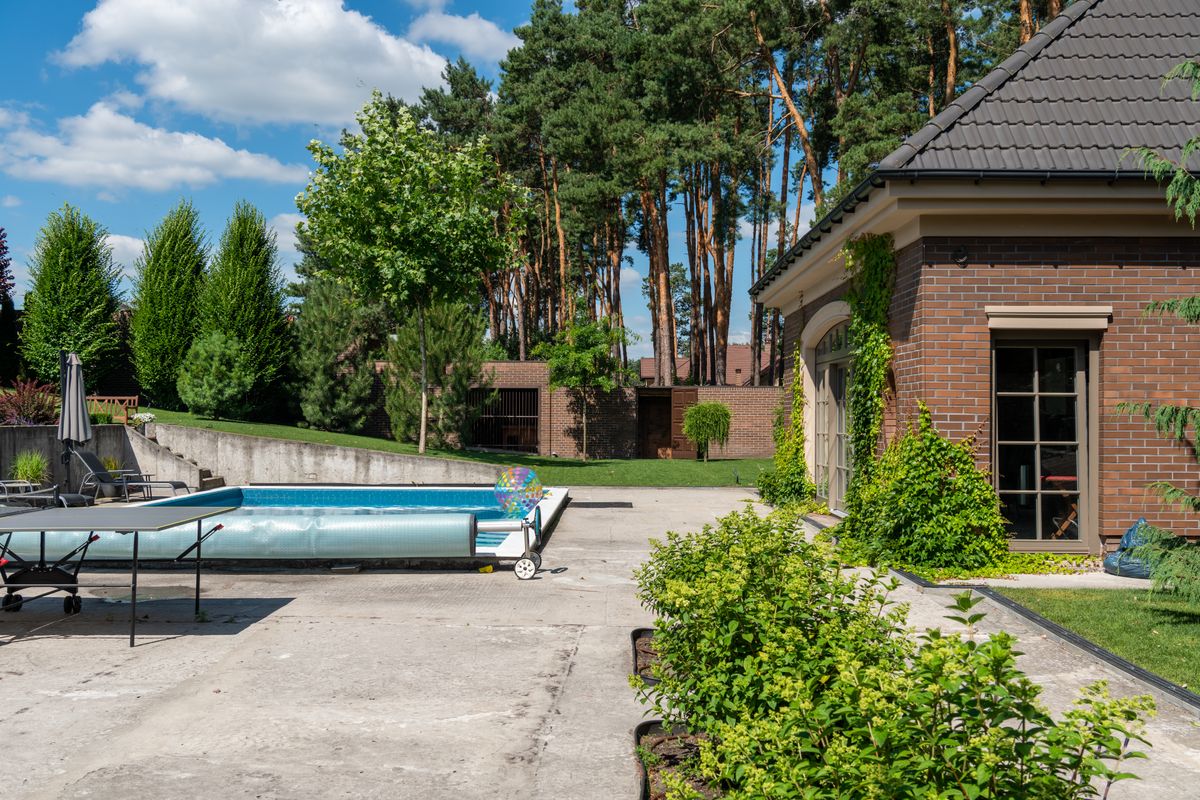
Central housing stock is mixed in a way the newer subdivisions south of here are not. Unpainted brick with a soft mortar joint wants a gentle detergent and a slow rinse - blasting a mortar line out of an older wall is a repair we cannot undo. Painted brick and painted hardboard are a different caution: paint on masonry can be chalked or already lifting at the edges, and pressure finds that edge every time. Hardboard and older composite siding, common on the 1980s and 1990s builds out here, swell and delaminate once water gets into a cut edge or an unsealed nail head, so those walls get low pressure and a controlled rinse angle, never a lance held close. We identify what we are standing in front of before the pump runs, because the wrong method on the right house is how a wash turns into a siding bill.
Artillery fungus and the spots that will not come off
If your beds are dressed in hardwood mulch and you have small dark specks stuck to the lower siding, garage door or car - specks that scratch off leaving a stain and laugh at a pressure washer - that is artillery fungus, and it is common on shaded, damp Central lots. We will remove what is removable and we will tell you plainly that the rest is mechanical: those spores cement themselves into the finish. Washing does not fix them, and any company that promises otherwise is selling you a second visit. The durable answer is changing the bed - pine straw or stone instead of decomposing hardwood mulch against the wall. Same honesty applies to a few other things we meet out here: rust bled deep into porous brick, a wall whose paint is already chalking to the touch, and rotted trim or soft sheathing. Those get quoted as what they are, or refused, rather than washed and called clean.
Big lots, septic fields and where the rinse water goes
Lots out here are large, a good share of the properties run on septic rather than parish sewer, and several sit low enough that standing water after a hard rain is a normal part of the year. That changes how we set up. We do not park a rinse over a septic field or a drip line if we can help it, we keep solution off the beds you care about by pre-wetting and rinsing plantings, and we pay attention to where the runoff actually ends up rather than assuming it disappears. On a low back corner that means finishing in a direction that moves water away from the foundation rather than pooling it against the slab. None of this is complicated, but it is the difference between a clean house and a clean house with a dead azalea bed and a rutted low spot.
When to book it, and what the visit looks like
Two moments make sense in Central. The first is after the spring pollen finishes, once the oaks have dropped and the yellow coat has stopped renewing itself every night - washing mid-pollen just buys you a week. The second is before something is being looked at: an insurance inspection, an appraisal, a listing, or a roof and gutter check after a storm season that has left litter packed against the walls. On the day, we walk the house first, cover or wet what needs it, treat the growth and give it dwell time, rinse from the top down, and hand-detail the entry, the porch ceiling and the areas people actually stand next to. A typical single-story here runs a couple of hours. You get a flat price up front after we have seen the house, not a per-hour meter, and if we find something a wash will not solve you hear about it during the walk, not in an invoice.
Central sits at the northeast edge of East Baton Rouge Parish, and plenty of the homes we wash out here belong to families who work in the city and think of the whole area as Baton Rouge. The cleaning is the same either way, but the river-bottom damp and the flood-rebuilt lower walls described above are genuinely a Central problem rather than a city one. If your property is in the city proper - the Garden District, off Perkins, out toward Sherwood Forest - the page you actually want is our house washing Baton Rouge service, which covers the housing stock and the conditions there.